What's Next: Building in Public
Part 5 of "Zero to the App Store in 7 Days"
This is the last article in the series. If you have been following along, you know the story: I opened a terminal for the first time on March 24, built a fitness app with zero engineering background, and shipped it to the App Store in seven days.
That was five weeks ago. Nine versions shipped. Here is what happened since.
Where Pacenotes is today
The numbers, unfiltered:
- A few dozen users. Friends, family, colleagues, and a few strangers who found the app organically. No ads, no paid acquisition, no Product Hunt launch.
- 17,000+ activities synced across all users.
- 120,000+ km logged. Roughly three times around the Earth.
- 10 sport types tracked: running, cycling, swimming, hiking, walking, weight training, skiing, yoga, HIIT, and more.
- Training plans live for all distances: 5K, 10K, half marathon, marathon, plus a "Get or stay in shape" continuous plan.
- 89% push notification opt-in. Almost everyone who signed up has notifications enabled.
- 78% weekly retention. Of the users who signed up two weeks ago, 78% were active in the last 7 days.
- 9 App Store versions shipped in 5 weeks. From v1.0 to v1.9.
- App Store search: from 6th result to 1st when you search "pacenotes."
The infrastructure still costs €15 a month. One server in Helsinki running everything.
What is live right now
The app today looks nothing like v1.0. Here is everything a user gets:
Training coach:
- Ask the Coach: a built-in Q&A covering thousands of running questions: training load, pacing, nutrition, gear, and more. Like having a running coach in your pocket.
- A rules-based training plan engine powered by Jack Daniels' VDOT methodology, audited across 600 scenarios
- Two plan types: "Train for a race" (periodised: Base, Build, Peak, Taper) and "Get or stay in shape" (rolling, volume-building)
- Plans for every distance: 5K, 10K, half marathon, marathon
- Weekly recalibration every Sunday based on what you actually did
- Fitness trajectory: STARTED / NOW / PROJECTED race time estimates
Route generator (v1.9, just shipped):
- Generate a round-trip route from your location in three flavours: Scenic, Fast, or Trail
- Turn-by-turn guidance built into the activity recorder
- GPX export for loading into your watch
Studio:
- 120 exercises across strength, stretching, yoga, and mobility
- Custom routine builder: pick your exercises, set your reps and durations, save it
- Full-screen interval timer with voice countdown and exercise announcements
Tracking:
- Strava sync via OAuth and real-time webhooks
- Apple Health integration with background delivery (activities sync without opening the app)
- GPS activity recording with live map, crash recovery, and elevation tracking
- Effort score on every activity: a heart-rate-weighted measure of how hard that session actually was
- Activity detail with per-km splits, heart rate zones, and satellite route map
Training insights (v1.8):
- Exercise Load: tracks your weekly training load, ACWR score, and flags injury risk signals like load spikes, missing rest days, and elevated acute/chronic ratios. Full history across 12 weeks, 50 weeks, or all time.
- HR Efficiency: shows how your average heart rate at a given pace evolves over time. A downward trend is your aerobic fitness improving, right there in the data.
- More accurate HR zones: now calculated from per-second data instead of split averages
Data:
- Redesigned home screen (v1.9): your training block is front and centre with phase labels, a race countdown, and a tap through to your full plan
- New Stats tab (v1.9): Volume, Progress, HR & Zones, and Territory are now separate lenses
- Territory map showing every road you have ever run, in satellite view, across the world
- Personal records with rolling-window detection across all data sources
- Year-over-year comparisons and volume trend insights
- Share cards: branded images of any activity for Instagram or WhatsApp
Platform:
- Sign in with Apple, Google, or email
- Push notifications with smarter scheduling: daily reminders detect rescheduled sessions and skip automatically if you have already trained
- Profile pictures, activity photos, dark/light mode
- iOS live on the App Store, Android in closed beta
- Strava enrichment: activities upload automatically with GPS data, descriptions enriched with training context, Effort score, and a Pacenotes footer
What people are actually doing with it
This is the part that gets me out of bed in the morning.
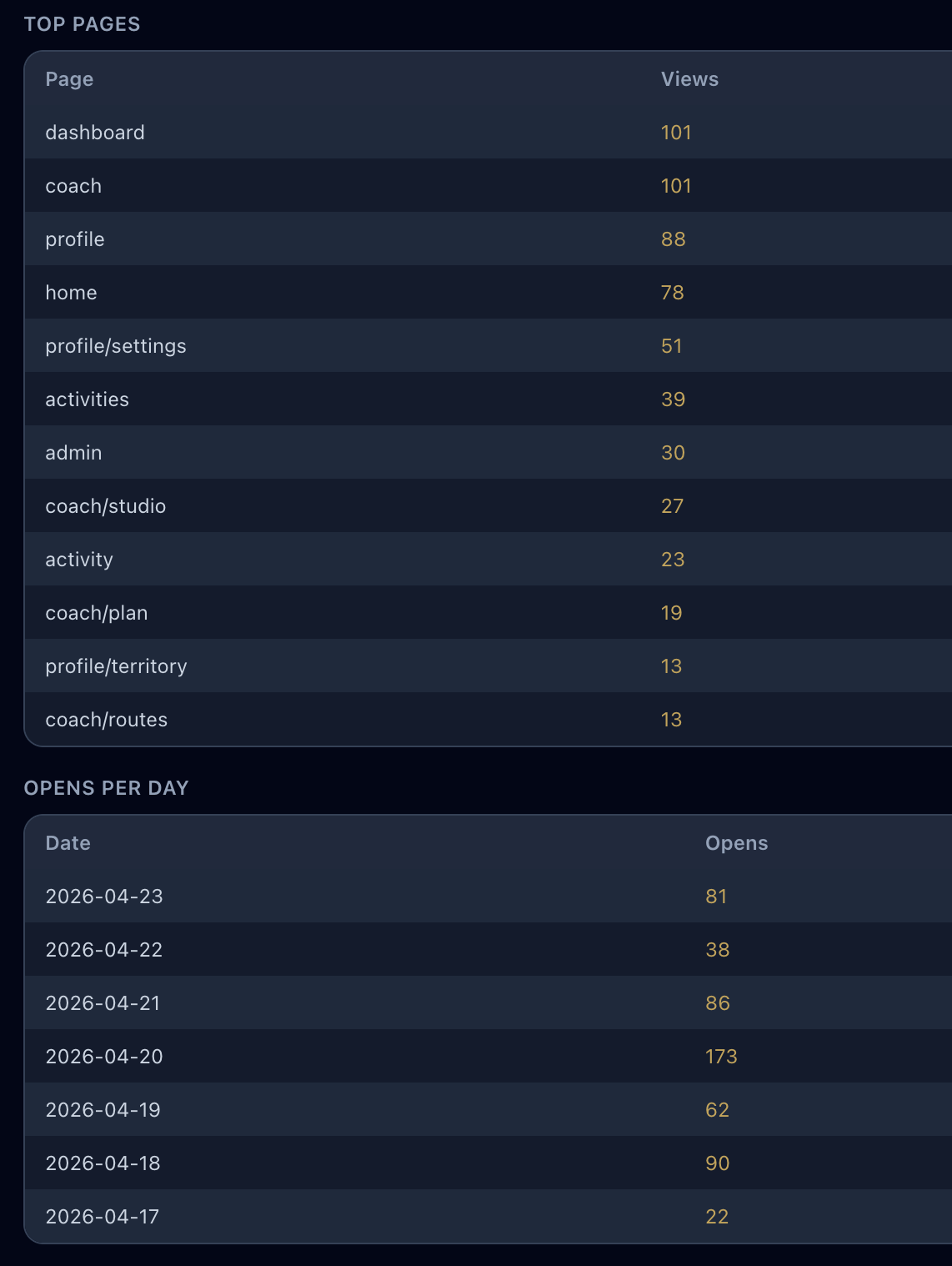
People are following training plans. Not just creating them: actually completing sessions, marking them done, and coming back the next day. I get feedback through the in-app form almost daily. Feature requests, bug reports, and the occasional "j'adore" that makes the late nights worth it.
Users open the app multiple times a day. The most active ones check the coach page more than any other screen. Some have synced thousands of activities and are exploring territory maps that span continents. One user has 3,800+ activities and a 10/10 engagement score.
But here is the biggest win: strangers are using the app to train for real races. Not friends doing me a favour. People I have never met, who found Pacenotes on their own, set a goal, committed to a plan, and are following it week by week. They send feedback. They report bugs. They request features. On a weekly basis.
The app is scalable-ish. It works on people's devices. And it is being used for its intended purpose by people who had no reason to be kind about it.
That is the moment a side project stops being a side project.
What is coming next
Next few days:
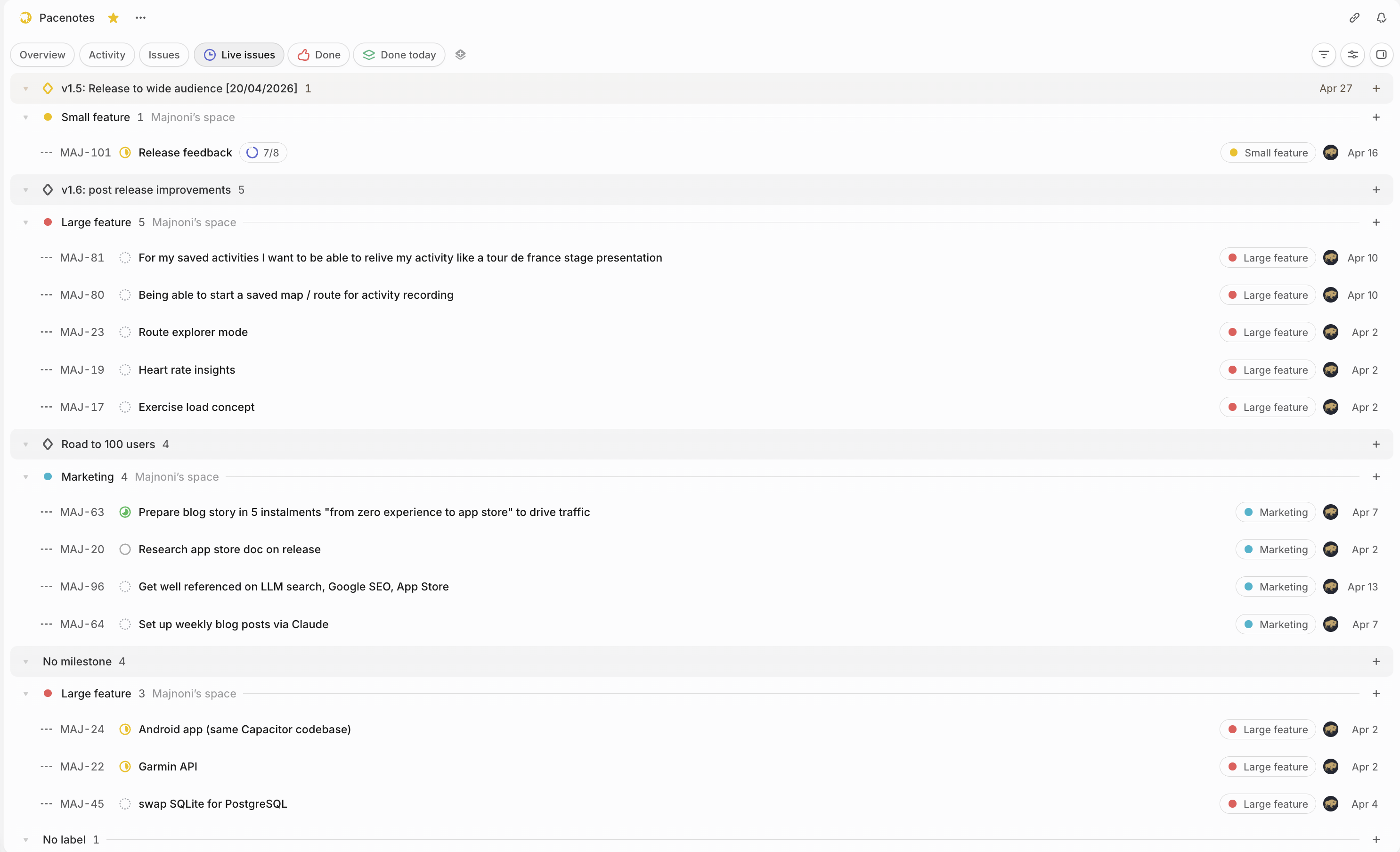
- Route explorer mode. A street coverage heatmap showing which roads you have run and which ones you have not, presented like a Tour de France stage profile. Elevation, distance, and the roads you have left to conquer.
Next couple of weeks:
- Multiple languages. The app is currently English-only. French is first, then we will see what users ask for.
- Voice routing. Turn-by-turn voice guidance during GPS recording, so you can follow a generated route without looking at your phone.
- Ultra running training plans. Plans beyond the marathon: 50K, 80K, 100K. Different periodisation, different volume targets, different philosophy.
- Android production release. Currently in closed beta on Google Play. Still looking for beta testers. If you have an Android phone, DM me on LinkedIn.
- Garmin direct integration. Developer portal application submitted. This unlocks richer data and means Garmin users do not need Strava as a middleman.
When the time is right:
- AI race predictor. Three prediction methods combined, all the maths shown transparently. "Garmin tells you a number. Pacenotes shows you why."
- PostgreSQL migration. SQLite is perfect for a few dozen users. At 1,000, the write locks become a problem. The migration path is planned; the trigger is user growth.
- Payments. The coach is free and always will be. Premium features will come at a price that reflects the infrastructure cost, not a VC's growth target.
Why build in public
I have been asked this a few times now. Why share the bugs, the costs, the architecture, the user numbers? Why not just ship quietly and market when it is ready?
Three reasons.
Accountability. Writing these articles forces me to reflect on what I built and why. The act of explaining a decision reveals whether it was actually good. Several times while drafting this series, I caught things I needed to fix, assumptions I had not questioned, and shortcuts that needed cleanup.
Feedback. The friends-and-family wave has already produced feature requests I would never have thought of: changing tempo run segments, planning multiple races, scheduling training around personal calendars. Real users find real gaps. You cannot get that feedback without putting the product in front of people and being honest about where it stands.
Proof. Five weeks ago, I had never opened a terminal. Today there is a real app on the App Store with real users logging real kilometres. If someone reading this has an idea but thinks they need an engineering degree to build it: you do not. The tools exist. The barrier is lower than it has ever been. The hard part is not the code. It is the decision to start.
Thank you
If you have read all five articles: thank you. Writing this series has been as valuable as building the app itself. Every article forced me to organise what I learned, and every comment and message from readers reminded me why sharing the journey matters.
If you are a runner or cyclist, Pacenotes is free on the App Store. Connect your Strava or Apple Health and see what your training looks like in one place.
If you have an Android phone, the beta is open. DM me on LinkedIn for access.
If you want to follow what comes next, the Pacenotes LinkedIn page is where I post product updates. My personal profile is where I post the building-in-public stories.
And if you are sitting on an idea that will not leave you alone: open a terminal. You might surprise yourself.
🦬
Pacenotes is free on the App Store. Android beta: DM me on LinkedIn for access.